
🚚 FREE Delivery on orders above 300 AED (UAE only) | ⏳ Limited Time Flash Sale – Hurry Up!
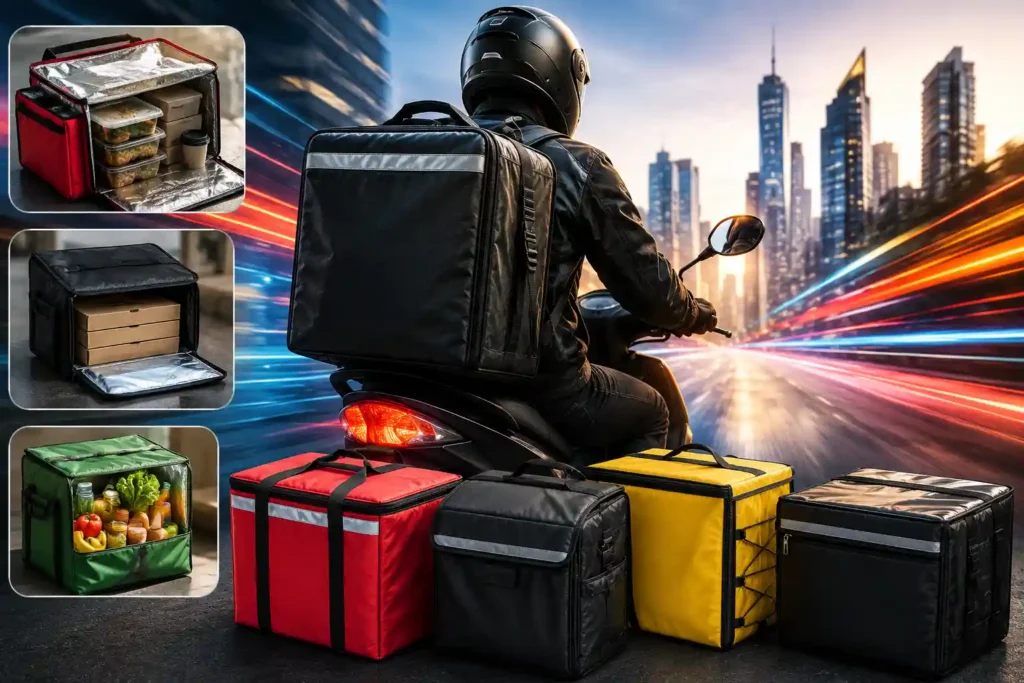
Ask any rider what ruins a shift faster than bad traffic, and most of them won’t say rain or red lights. They’ll say a bad bag.
You know the feeling. You’re three orders deep, the customer’s building has no elevator, and when you finally get to their door, the box has slid sideways and the soup lid popped open inside your bag. Now you’re apologizing at the doorstep instead of collecting a tip.
That’s not bad luck. That’s a bag problem.
Most riders don’t think about their delivery bag until it fails them — usually at the worst possible moment. So before you’re standing outside someone’s door with a leaking bag and a 1-star rating on the way, let’s actually talk about what separates a good delivery bag from one that’s quietly costing you money every single shift.
Here’s the math nobody does: if a bad bag causes even one ruined order a week — a spilled drink, a cold pizza, a squished cake — that’s one bad review, one refund request, and possibly one platform warning. Do that for a few months and it adds up to lost trust, lower ratings, and fewer high-paying orders sent your way.
A decent bag isn’t an expense. It’s the thing standing between you and that outcome.
Forget the marketing words for a second. Here’s what matters when you’re the one carrying it for 8+ hours a day.
Plenty of bags are warm for the first ten minutes and useless after that. The difference usually comes down to what’s actually inside the lining. A single thin foil sheet does almost nothing. What you want is a proper foam layer combined with a reflective lining — that combo is what actually slows down heat loss over a long ride, not just a short walk to the door.
This sounds obvious until you’re the one pulling out a melted milkshake next to a pizza. If your bag doesn’t separate hot food from cold drinks, condensation and steam will ruin one or the other. Multiple compartments aren’t a luxury feature — they’re the whole point. This is exactly why bags designed for catering-style volume, like a heavy duty hot and cold delivery bag with triple-layer insulation, build separation into the design instead of treating it as an afterthought.
A lot of “waterproof” bags are really just water-resistant for light drizzle.If you’re riding through actual rain, you want tarpaulin-style exterior material, not regular polyester that soaks through after twenty minutes. Bags like Alzohr 62L insulated delivery bag built for e-bikes and motorcycles use this kind of heavy-duty exterior specifically because riders deal with real weather, not just a quick dash from the kitchen to the curb.
Riders rarely talk about this, but strap design changes everything on long shifts. A bag that sits low and swings with every turn will wreck your back faster than the actual riding does.Look for padded straps that sit close to your body, or a rack-mounted option if you’re constantly stopping and starting.
You won’t notice bad stitching on day one. You’ll notice it on day forty, when a strap rips off mid-shift with a hot order inside.Reinforced stitching and metal zipper pulls (not plastic) are a small detail that tells you a lot about how the bag was actually made.
This isn’t really a “better or worse” debate — it’s about your vehicle and your route.
If you’re on a bike or scooter and weaving through apartment buildings all day, a backpack-style bag makes more sense. It stays close to your body, doesn’t swing into door frames, and you’re not constantly unstrapping it from a rack just to carry it up three flights of stairs.
If you’re on a motorcycle, e-bike, or doing longer routes with bigger orders, a rack-mounted box bag wins. You get way more capacity, your back doesn’t carry the weight, and it’s more stable at higher speeds.
Riders who switch between both usually end up keeping one of each — a smaller backpack bag for quick single orders, and a bigger rack bag for catering-heavy days. If storage space is tight, something like an insulated delivery bag with large capacity that folds flat is worth a look too, since it won’t eat up trunk or closet space between shifts.
If you’re shopping around, here’s how three real options from Alzohr stack up against each other — useful if you’re trying to figure out which size actually fits your delivery style instead of guessing from a product photo.
| Bag | Best For | Standout Feature |
|---|---|---|
| Insulated Food Delivery Bag – Large Capacity | Daily food delivery, grocery runs, pizza & beverages | 23″ × 15″ × 14″ size, lightweight, foldable design with waterproof aluminum lining to keep food hot or cold for hours. |
| 62L Insulated Food Delivery Bag for E-Bikes & Motorcycles | E-bikes, scooters, motorcycles & multi-order deliveries | 62L capacity, waterproof 500D tarpaulin, magnetic flap closure, fiberglass frame, and 8 built-in cup holders. |
| Heavy Duty Hot & Cold Food Delivery Bag (24×15×14″) | Catering, large takeout orders & grocery delivery | Triple-layer insulation, holds up to 60 lbs, dual heavy-duty zippers, and maintains food temperature for extended periods. |
Each of these gets covered in more detail earlier in this guide. If none of them match exactly what you need, Alzohr full range of delivery bags has more sizes and capacities to compare side by side.
A properly insulated bag with foam and reflective lining should hold heat for at least 45 minutes to an hour in normal weather. If your bag goes cold in 15-20 minutes, the insulation isn’t doing its job.
Yes, but only if it has separate compartments. Without separation, steam from hot food creates condensation that warms up cold drinks and makes everything soggy.
No. A bag that’s too big lets food slide around during turns and braking, which causes spills. Match the bag size to your typical order volume, not the biggest one available.
Build quality matters more than style here. A well-made backpack bag will outlast a poorly stitched rack bag, and vice versa. Check stitching and zipper quality regardless of which style you pick.
You don’t need the flashiest bag on the market. You need one that survives your actual shift — the rain, the bumps, the back-to-back orders, the stairs with no elevator. Get that part right, and your ratings, your tips, and honestly your patience will all hold up a lot better too.